
BP Monitor Cuff Sizing Guide (2026)
By the BP Monitor Lab editorial team · Written from manufacturer documentation and published guidance, not from our own device testing · Updated: October 6, 2026
The wrong cuff size is the most common error in office blood pressure readings, according to the American Heart Association's 2019 statement on measuring blood pressure. A cuff that is too small reads too high. A cuff that is too large reads too low. Measure your arm, pick the right size, and trust your numbers.
How to Measure Your Upper Arm
- Drop your non-dominant arm at your side. Relax the muscles.
- Find the bony tip of your shoulder and the bony tip of your elbow.
- Mark the midpoint with a finger or a pen dot.
- Wrap a soft tape measure around that midpoint.
- Keep the tape level and snug. Do not pull tight.
- Read the number in centimeters. That is your arm circumference.
It has to be a cloth or vinyl tape. A builder's steel tape will not lie flat around an arm and will read short. If there is not one in the house, a length of string measured against a ruler afterwards works perfectly well, and so does any soft tape measure. This is the one step worth not guessing at: cuff size is decided by this number, and a cuff one size too small reads high every single time.
AHA Cuff Size Chart
These are the sizes in the American Heart Association's 2019 statement on measuring blood pressure. The statement notes that cuff sizes differ by maker, so the range printed on your own cuff is the one to go by. Inches are our conversion.
| Arm Size (cm) | Arm Size (in) | Cuff Size |
|---|---|---|
| 22 to 26 | 8.7 to 10.2 | Small adult |
| 27 to 34 | 10.6 to 13.4 | Adult |
| 35 to 44 | 13.8 to 17.3 | Large adult |
| 45 to 52 | 17.7 to 20.5 | Extra-large adult |
The Cuff in the Box, by Model
This is the cuff that ships with each monitor we cover, from our product records. It is not every cuff the maker sells.
| Monitor | Cuff in the box | Larger cuff named in its own listing |
|---|---|---|
| Omron Platinum (BP5465) | 9 to 17 inches | None in our record |
| Omron Gold (BP5360) | 9 to 17 inches | None in our record |
| Omron Silver (BP5255) | 9 to 17 inches | None in our record |
| Omron Bronze (BP5150) | 9 to 17 inches | None in our record |
| Omron Iron (BP5000) | 9 to 17 inches | None in our record |
| Omron Evolv (BP7000) | 9 to 17 inches | None in our record |
| Omron Complete 2-in-1 (BP7900) | 9 to 17 inches | None in our record |
| Withings BPM Connect (WPM05) | 8.7 to 16.5 inches | None in our record |
| Withings BPM Vision (WPM07-08) | 8.7 to 16.5 inches | 40 to 52 cm, sold separately |
| Beurer BM67 (BM67) | 8.6 to 16.5 inches | None in our record |
| Beurer BM26 (BM26) | 8.7 to 16.5 inches | None in our record |
| A&D Medical UA-651BLE (UA-651BLE) | 9 to 14.6 inches | None in our record |
| A&D Medical UA-651 (UA-651) | 8.6 to 16.5 inches | None in our record |
| A&D Medical UA-767F (UA-767F) | 8.6 to 16.5 inches | None in our record |
| Welch Allyn Home 1700 Series (H-BP100SBP) | 8.75 to 16.5 inches | 40 to 54 cm, sold separately |
| iHealth Track (KN-550BT) | 8.7 to 16.5 inches | None in our record |
| Greater Goods Blood Pressure Monitor (0602) | 8.75 to 16.5 inches | None in our record |
If your arm is over 17 inches
Most home monitors stop at 17 inches, including every one we recommend. If you measured more than that, a standard cuff will read high and no amount of careful technique fixes it.
Every option we can support above 17 inches
Two of these are validated in the large configuration, meaning the model's own entry on the validated device listing names the big cuff. The third fits a large arm without that being true, and the difference is the whole point of the table.
| Configuration | Large cuff range | Validated at that size? | Syncing |
|---|---|---|---|
| Welch Allyn Home 1700 | 40 to 54 cm | Yes. The XL cuff is named in its own listing (H-BP100SBP, AASN-224) | Bluetooth |
| Withings BPM Vision | 40 to 52 cm | Yes. Both cuffs are named in its listing (WPM07-08) | Wi-Fi and Bluetooth |
| Withings BPM Connect plus the XL cuff | 40 to 52 cm | No. The cuff fits, but this model's validation covers 22 to 42 cm. A fitting solution, not a validated configuration. | Wi-Fi and Bluetooth |
If your arm is above 17 inches, the first two are the only devices on this site whose own evidence covers you at that size. The third is still better than forcing a standard cuff, because a cuff that does not fit is the larger error by a wide margin. It is simply not the same claim, and we will not present it as one. Nothing beyond 54 cm is served by any home monitor we track; that is a clinic measurement.
A large arm and an independent validation, in one device
This is the combination that is genuinely hard to find, because the monitors that take a very large cuff are usually the ones with no validation we can point at. One exception is worth knowing about. The Welch Allyn Home 1700 Series appears on the US Blood Pressure Validated Device Listing as H-BP100SBP, model AASN-224, and its listing names three cuffs: XS at 15 to 24 cm, standard at 22 to 42 cm, and XL at 40 to 54 cm. The validation and the large cuff belong to the same listed device, which is the part that usually breaks.
Buying an XL cuff for a monitor whose listing does not include one is a different situation. It will fit your arm, which is the larger error solved, but the device was not validated in that configuration and we will not tell you it was.
The one first-party option we found is the Withings XL Blood Pressure Cuff, which fits 15.8 to 20.5 inches. Withings makes it and it attaches to the BPM Vision, which is sold separately. Check that your monitor is a BPM Vision before buying it.
We do not recommend the generic "fits most monitors" cuffs sold cheaply online. A cuff is part of the measuring instrument, not an accessory like a case. One that was never tested with your monitor can shift the reading, and that reading may decide whether you start or change medication. If nothing from your monitor's own maker fits, ask your doctor or pharmacist to measure you on a properly sized cuff instead.
Monitors That Fit Each Arm Size
The cuff in the box fits 9 to 17 inches. Independent evidence we can cite: ISO 81060-2, plus US validated device listing.
The cuff in the box fits 8.7 to 16.5 inches. Independent evidence we can cite: ISO 81060-2, plus US validated device listing.
The cuff in the box fits 8.6 to 16.5 inches. Independent evidence we can cite: None we could verify.
The 40 and 80 Rule
Cuff sizes are printed as arm ranges because that is what shoppers can use, but the ranges themselves come from a rule about the inflatable bladder hidden inside the fabric. It is worth knowing, because it explains why a cuff that physically fastens around your arm can still be the wrong cuff.
The American Heart Association's 2019 statement gives these ranges for the bladder:
- • Length: 75% to 100% of your arm circumference.
- • Width: 37% to 50% of your arm circumference.
The same statement says a cuff that is too small gives a falsely high reading, and a cuff that is too large gives a falsely low one. So wrapping a standard cuff tightly around a large arm does not rescue it. The fabric reaches, but the bladder inside is still too small for the arm.
Proper Placement on the Arm
The right cuff in the wrong place gives away most of what you gained by buying it. Five things decide placement.
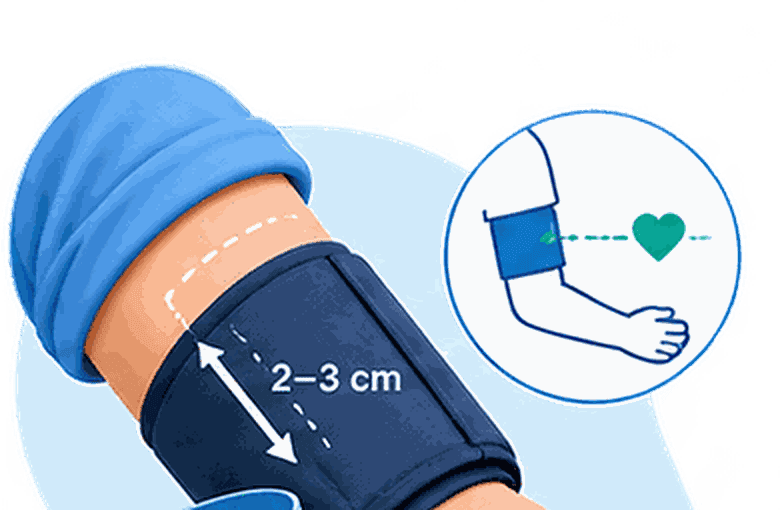
- 1. Bare skin. Take the arm out of the sleeve rather than pushing the sleeve up, because a rolled sleeve acts as a second, uncontrolled cuff above the real one.
- 2. Bottom edge 2 to 3 cm above the elbow crease. Roughly one finger's width. Too low and the cuff fights the tendons at the bend of the elbow.
- 3. Artery marker over the inside of the arm. Most cuffs print an arrow or an index line; it lines up with the middle of the inner arm, roughly in line with the little finger.
- 4. Snug, not tight. One finger should slide under the top and bottom edge easily. Two should fit, but only just.
- 5. Supported at heart height. Rest the arm on a table. Holding it up yourself tenses the muscle and raises the number.
Most cuffs also print a range marker: an index line that should land inside a bracketed “OK” zone when the cuff is wrapped. If your arm puts that line outside the bracket, the cuff is the wrong size for you, and the device is telling you so directly. It is the one piece of sizing feedback you get for free, and almost nobody looks for it.
Where this comes from
Guideline and evidence last checked: 2026-10-04. We publish what these sources say. Where they decline to give a rule, we say that instead of inventing one.
- •Home Blood Pressure Monitoring, American Heart Association
- •Measurement of Blood Pressure in Humans: A Scientific Statement From the American Heart Association (2019), American Heart Association, 2019-03-04
- •Effects of Cuff Size on the Accuracy of Blood Pressure Readings: The Cuff(SZ) Randomized Crossover Trial (JAMA Internal Medicine, 2023), Ishigami J, et al. JAMA Internal Medicine, 2023-10-01
- •7 Simple Tips To Get an Accurate Blood Pressure Reading, CDC Million Hearts, adapted from the American Medical Association and Johns Hopkins University
How a Wrong Cuff Skews Readings
These numbers come from one study, the Cuff(SZ) randomized trial, published in JAMA Internal Medicine in 2023. It measured 195 adults with a regular adult cuff and with the cuff that fit their arm, and compared the two. It used one automated monitor in a research clinic, so treat the figures as that trial's results and not as a rule for every monitor.
| Regular cuff used on an arm that needed | Top number (systolic) | Bottom number (diastolic) |
|---|---|---|
| A small cuff (regular is too large) | 3.6 mmHg too low | 1.3 mmHg too low |
| A large cuff (regular is one size too small) | 4.8 mmHg too high | 1.8 mmHg too high |
| An extra-large cuff (regular is two sizes too small) | 19.5 mmHg too high | 7.4 mmHg too high |
A cuff over a sleeve is a separate mistake. A CDC Million Hearts tip sheet estimates that a cuff over clothing adds 5 to 50 mmHg.
Related Reading
- How to take accurate blood pressure at home
- How often should you check your blood pressure
- Best blood pressure monitor for home
- Upper arm vs wrist BP monitor
Frequently Asked Questions
What is the 40 and 80 rule for blood pressure cuffs?
We could not find that rule in a current source, so we do not repeat its numbers. The American Heart Association's 2019 statement on measuring blood pressure gives ranges for the inflatable bladder inside the cuff. Bladder length should be 75 to 100 percent of your arm circumference, and width 37 to 50 percent. A cuff that is too small gives a falsely high reading.
Where exactly should the cuff sit on my arm?
On bare skin, with the bottom edge 2 to 3 cm above the crease of your elbow, and the artery marker printed on the cuff lined up with the middle of your inner arm. Snug enough that one finger slides under the edge easily. Then rest the arm on a table so the cuff is level with your heart.
How do I measure my upper arm for a BP cuff?
Drop your arm at your side. Find the midpoint between the bony tip of your shoulder and your elbow. Wrap a soft tape measure around that point. Keep the tape snug but not tight. The number in centimeters is your arm circumference.
What happens if the cuff is too small?
It reads too high. In one randomized trial of 195 adults, a regular cuff on an arm that needed a large cuff read the top number 4.8 mmHg too high. On an arm that needed an extra-large cuff, it read 19.5 mmHg too high.
What happens if the cuff is too big?
It reads too low. In the same trial, a regular cuff on an arm that needed a small cuff read the top number 3.6 mmHg too low.
Do BP monitors come with extra cuff sizes?
Most monitors ship with one cuff. The table on this page lists the cuff in the box for every monitor we cover. Two of them, the Welch Allyn Home 1700 and the Withings BPM Vision, have an extra-large cuff named in their own validation listing. It is sold separately.
Should I round up or down when my arm is on the border?
Go by the arm range printed on the cuff. If your arm falls on the line between two cuffs, ask your healthcare professional or pharmacist. The American Heart Association says to have them check that you have the correct cuff size and fit.
Do wrist monitors need to be sized?
Most wrist cuffs adjust within a single range (13.5 to 21.5 cm). They are less forgiving on position than on size. Keep the wrist at heart level.
How tight should the cuff be?
Snug, not tight. The American Heart Association's 2019 statement on measuring blood pressure says one finger should fit easily at the top and bottom of the cuff. Two fingers should fit, but will be very snug.
Can I share a cuff with someone in a different size range?
Only if both arms fall inside the cuff's printed range. Mark the range on the cuff itself or use a monitor with a wide-range cuff. Two-user models like the Omron Platinum store readings separately even when the cuff is shared.
Primary Sources
- American Heart Association. Home Blood Pressure Monitoring. heart.org
- ValidateBP.org. Independently validated monitors list. validatebp.org